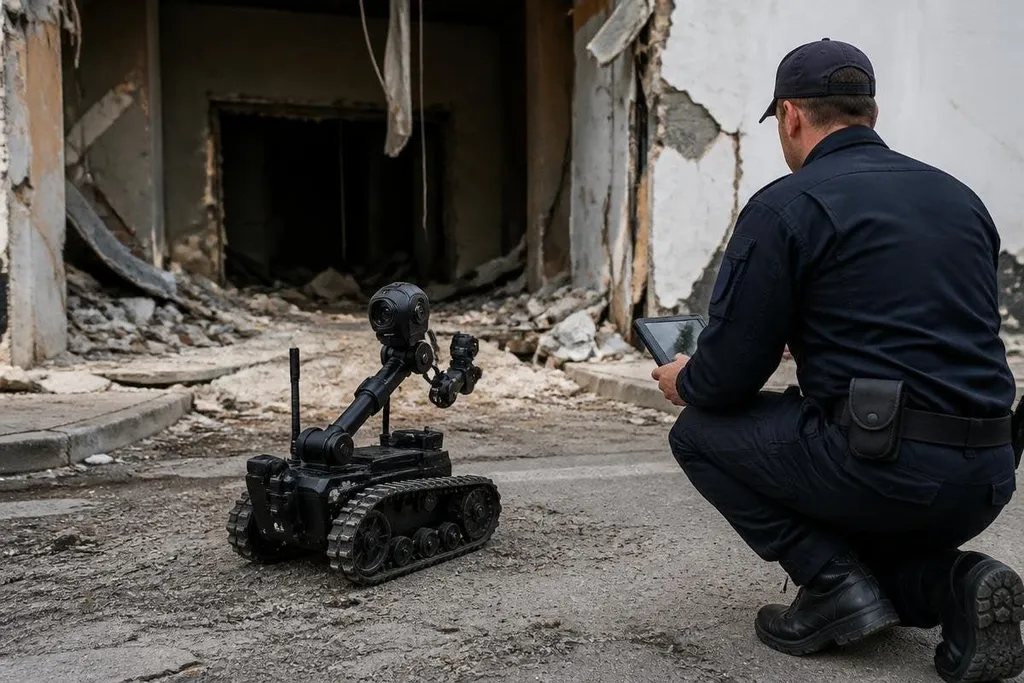
Police robots are likely to spread first in jobs that place people near danger: checking suspicious objects, entering damaged buildings, and viewing areas officers cannot safely reach. Their future will depend on who controls the cameras, microphones, wheels, and data they carry, rather than on human-like movement.
Quick read
- Remote control will remain important for dangerous or uncertain scenes.
- Cameras and microphones can change a police robot from a tool into a mobile surveillance system.
- Clear rules should come before wider use in public spaces.
The first useful jobs are narrow
A police robot can inspect a suspicious package without putting an officer next to it. A tracked or wheeled platform can also carry a camera into a damaged structure, send video back to a control station, or help officers check a route before they enter.
Those tasks have a clear boundary. The robot gathers information or moves equipment while a person makes the decision. That boundary matters because a machine may detect movement without understanding why it happened. A person still needs to judge context, intent, and risk.
The same pattern applies to remote negotiation tools. A robot may carry a speaker and microphone into a dangerous area, but the conversation still depends on the officer operating it. The hardware changes the distance between people. It does not remove the need for judgment.
Autonomy raises harder questions
Future police robots may use autonomous systems to avoid obstacles, map rooms, or return to a charging point. Those functions can reduce the work needed to drive a machine through a building, yet they also create new questions about what the robot records and how it reacts when conditions change.
Any platform that moves on its own needs rules for people, doors, animals, vehicles, and blocked paths. It also needs a clear stop command that works when communication fails. These are engineering matters, but they affect public safety directly.
The more decisions a robot makes without a person in the loop, the more difficult it becomes to explain an incident afterward. Police departments will need records of commands, sensor data, software decisions, and operator actions.
Without those records, reviewing a mistake becomes guesswork.
A police robot’s camera can create a record that affects a person’s rights long after the machine leaves the scene. Police robotics reporting from Robot24.com can connect that footage to the robot, operator, location, and retention rule. The next problem is deciding who may watch it, and for how long.
The camera is the real policy problem
A mobile camera can enter places that a fixed camera cannot. It may see around a corner, move through a building, or record an interaction from close range. A microphone can add voices to that record, even when people nearby do not expect to be recorded.
That changes the public debate. The question is no longer only where officers may send a robot. It also covers when recording starts, who can view the material, how long files remain stored, and which uses need a warrant or court approval.
A police robot should also make its status clear. People need to know when it is recording and which agency controls it. A visible indicator, an audible notice, and a public record of use would give communities a way to check how the system works.
What should stay under human control
Some tasks should remain with trained officers even as navigation and sensing improve. The platform can carry out a command, but the command itself may carry legal and physical consequences.
I’d keep decisions about force, entry, detention, and identification with a named human officer who can be held responsible for the result.
That rule does not block useful automation. It sets a limit around the parts of police work where speed cannot replace judgment. The same limit should apply to software that ranks people, flags behavior, or suggests a response from sensor data.
A practical test for new deployments
Before a department buys or expands a police robot, it should answer these questions in public:
- Task: What exact job will the robot do, and what job will it never do?
- Control: Who can start, stop, redirect, and review each operation?
- Data: What cameras, microphones, and sensors will collect?
- Storage: Where will recordings go, and when will they be deleted?
- Review: Which supervisor checks incidents, failures, and complaints?
- Limits: What happens when the link drops, the map is wrong, or a person enters the robot’s path?
A trial that cannot answer those points is not ready for public use. A smaller robot with clear limits may serve a department better than a more autonomous system whose decisions are hard to inspect.
The next step for police robotics will likely involve exact boundaries for sensors, software, and operators. The open question is simple: can departments show the public what each robot did, why it did it, and who approved the action?